envecon 2026
keeping nature in the conversation
Applied Environmental Economics Conference
Friday, 20th March 2026 | The Royal Society, London
About envecon
envecon this year had two main aims.
The first is in the name – to keep nature in the conversation.
We are living in a time when the world is grappling with rising tensions, potential armed conflicts and cost of living crises.
Even those decision makers who are aware of the economic importance of nature are finding it difficult to make the argument.
The second is to honour two leaders in environmental economics, Prof Willis (d. 2025) and Prof Pearce (d. 2005).
They inspired many of us to enter - and stay - in this profession.
They tirelessly and innovatively repeated the message that, without nature, there is no life, no economy, no growth.
They also understood that solutions lie in collaboration with others and that the economist’s role is to draw together insights from multiple disciplines to build cohesive and comprehensive arguments.
This year’s programme did show the strength of economic evidence, taught about tools to improve how we communicate that evidence and we renewed our shared commitment, energy and sense of camaraderie across the network.
Watch the envecon 2026 Keynote Speech from Anjali Goswami
Welcome note by Ece Ozdemiroglu, co-founder of UKNEE and CEO of eftec.
As an evolutionary biologist who has recently joined the government service, Prof Goswami reminded us about the differences in time line and preferences for certainty. While policy is made for human life time, evolution looks at millions of years. While uncertainty is something to be eliminated in policy work (as if such a thing is possible), for evolutionary biologists it is the norm.
Prof Goswani also reminded us we need to stop thinking about nature as a reactant – something we simply consume and make sure it is treated as a catalyst: a system that enables, supports, and enhances the processes we depend on. So, our way to keep nature in the conversation (theme of the conference) is to show how investing in nature, as a catalyst, will help manage what opinion polls say people care the most about: cost of living, immigration, health. She set the day off to a great start, reminding us how sciences and economics are best when they work together.

For recordings of all other envecon 2026 sessions, as well previous envecon conferences and webinars, click here to join UKNEE.
Membership also includes access to our members' directory and a subscription to our journal.
envecon 2026 Agenda
Keynote Speaker: Anjali Goswami
09:30 - 10:00

Professor Anjali Goswami was appointed Chief Scientific Adviser and Director General Science, Data and Analysis at the Department for Environment, Food and Rural Affairs on 1 July 2025.
Anjali is a research leader in evolutionary biology and former Dean of Postgraduate Education at the Natural History Museum, London, an Honorary Professor in the Department of Genetics, Evolution and Environment at University College London, and Past President of the Linnean Society of London.
She received her B.Sc. from the University of Michigan in 1998 and her PhD from the University of Chicago in 2005, followed by a US National Science Foundation fellowship held at the Natural History Museum and a JRF at King’s College and lectureship in Earth Sciences at the University of Cambridge. Her expertise is in vertebrate evolution and development, particularly in the emerging area of evolutionary phenomics. She and her group develop and apply new approaches to capturing the complex three-dimensional shapes of organisms in order to reconstruct the evolution of biodiversity. Her work spans insects to dinosaurs, but her main interest is in the evolution of mammals. To fill key gaps in the palaeontological record, she has searched for fossils from Svalbard to Madagascar, with her primary fieldwork being based in South India.
She is the recipient of the Linnean Society Bicentenary Medal, the Zoological Society of London Scientific Medal, the Hind Rattan Award, the Society of Vertebrate Paleontology Robert L. Carroll award, the Palaeontological Association President’s Medal, and the Humanists UK Darwin Day Medal. She was elected to the fellowship of the Royal Society of London in 2024.
Session 1: Professor Ken Willis Session on next frontier for economic valuation: Biodiversity
10:00 - 11:10
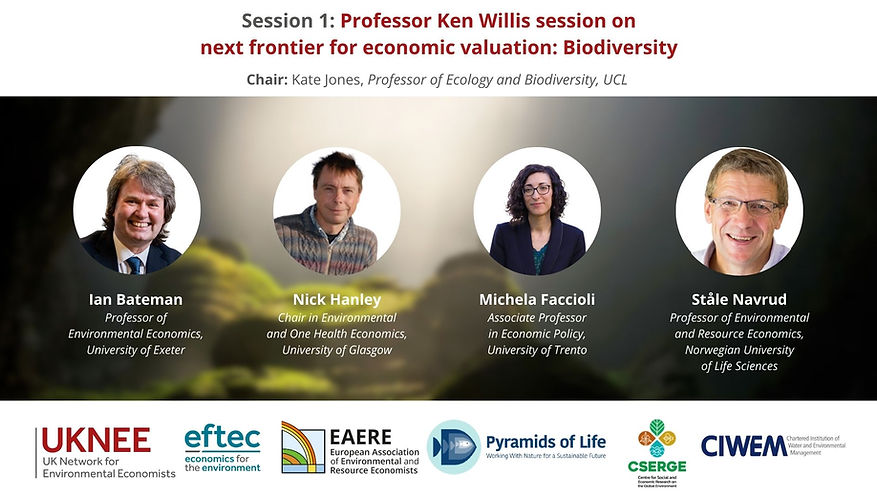

Ian Bateman
Co-Director of the LEEP
University of Exeter

Nick Hanley
Chair in Environmental and One Health Economics
University of Glasgow

Michela Faccioli
Associate Professor in Economic Policy
University of Trento (Italy)

Stale Navrud
Professor in Environmental Economics
Norwegian University of Life Sciences
Biological diversity – we know it underpins life on Earth, provides us with ecosystem services and makes us resilient. We set targets to preserve, conserve and enhance it. But there are many ways of measuring and valuing it – and this is not a theoretical discussion: different approaches produce different results, shape our decisions differently. On the valuation side, we will have a debate between welfare measurement and marginal abatement cost – which is better when. The debate will be chaired by a scientist as in this, more than any other topic perhaps, we need interdisciplinary approach.
Session 2: Professor David Pearce session on economics for environmental policy
11:25 - 12:50


Can Military Enforcement Curb Illegal Deforestation? Evidence from Colombia’s Largest National Parks
Diego Castro, PhD Candidate, University of East Anglia, UK
This article evaluates the effectiveness of military interventions in deterring illegal deforestation. We focus on Operation Artemis, an intervention conducted between 2019 and 2022, which used military units to target illegal deforestation hotspots in national parks of the Colombian Amazon. To identify causal effects, we use a novel approach that exploits geographic and temporal variation of hotspot policing strategies, along with legal restrictions on enforcement. We show that the military interventions were able to reduce illegal deforestation. However, our evidence suggests that hotspot policing may have limited effectiveness in deterring deforestation and is costly to enforce. Results are robust to two complementary difference-in-difference strategies.

Switching off public lighting at night: does preserving biodiversity come at the expense of public safety?
Chloé Beaudet, Postdoctoral Researcher, Paris-Saclay Applied Economics, France
Many French municipalities have recently adopted late-night public lighting switch-offs to reduce energy costs and impacts on biodiversity, raising concerns about public safety. This paper provides the first nationwide causal evaluation of these policies on crime. It relies on annual municipal-level crime data covering 11 crime categories for the period 2017-2023, combined with a novel satellite-based dataset that identifies public lighting switch-offs. Using a staggered difference-in-differences design, I show that switch-offs have no effect on most crime types. The only exception is a modest increase in burglaries, particularly in densely populated municipalities. Overall, these results provide reassuring evidence for municipalities implementing such policies, while suggesting that alternative lighting strategies (dimming, changing light color) may be more appropriate in dense urban areas, where a moderate increase in burglaries is observed and biodiversity is less prevalent.

Pay Up or Pile Up: Willingness to Pay for Waste Collection Services in Conakry
Household waste collection in Conakry faces major financial and governance constraints. We estimate households’ willingness to pay (WTP) for improved services using a Double-Bounded Dichotomous Choice model. Average WTP is 3.18 euros/month and is significantly shaped by household wealth, literacy, gender, mobile money access, remittances, and prior service access. The current subscription model covers only 22% of operating costs, limiting service expansion. A shift from subscription to a tax-based mechanism aligned with WTP could ensure financial sustainability if compliance reaches 59%. Widespread mobile money use could strengthen transparency, lower transaction costs, and support financial inclusion.

Informing climate-responsive social protection policy: Evidence from Tanzania
Dr Sylvia Blom, Principal Consultant, Oxford Policy Management, UK
Increasingly severe and frequent weather events threaten the resilience of low-income households in developing countries, particularly those engaged in rain-fed agriculture. This paper seeks to identify which weather shocks pose such a risk in Tanzania, and for whom. We find strong evidence that drought conditions as well as temperature extremes--both hot and cold--increase food insecurity. Small-scale farmers with non-diversified crop agriculture are particularly vulnerable to adverse weather conditions, and indicate scope for a climate-responsive social policy in Tanzania. Our findings highlight the need to use multiple measures of food security in analysis to inform climate-responsive policy, as our effects vary by outcome measure, consistent with known limitations of food insecurity indicators.
Session 3: Net Zero for Agriculture: behavioural and economic levers for a just transition
13:40 - 14:40


Sanchayan Banerjee
Associate Professor of Economics and Public Policy
Kings College London, UK
Do people like meat taxes? Evidence from four European countries
A meaningful dietary transition requires robust fiscal policies, such as a meat or dairy tax. A common misconception is that citizens uniformly oppose meat taxes, making them politically unviable. Opposition stems from poor design, not the concept of carbon taxes itself. Experimental evidence highlights that the solution lies in better tax design, not softer nudges. Additional results show that conservative voters may support meat taxes more than left-wing voters, if designed correctly.

Simon Dietz
Professor of Environmental Policy
London School of Economics and Political Science, UK
The social welfare value of the global food system
The global food system provides nourishment to most of the world's eight billion people, generates trillions of dollars of goods and services, and employs more than one billion people. On the other hand, it generates substantial dietary health costs and environmental harms. Policymakers are asking about the overall contribution of the global food system to social welfare and how much larger it might be on a sustainable path. This paper uses a large-scale integrated assessment modelling framework capable of quantifying the outcomes of different food-system scenarios. We find that a bundle of measures in a Food System Transformation scenario would provide a large boost in global social welfare, increasing GDP by about 7%, with a change to diets as particularly beneficial.

Dr Lisa-Maria Tanase
University of Cambridge Political Psychology Lab, UK
Do politicians underestimate public support for Net Zero policies?
Social norm literature shows that citizens often underestimate climate policy support, contributing to a Spiral of Silence, discouraging advocacy. Whether politicians hold such misperceptions remains an open empirical question, with serious implications for democratic representation, trust, and the pace of climate mitigation. This study finds both supportive and opposed politicians systematically underestimated public support for climate policies. Perceiving lower public support significantly reduced willingness to advocate for these policies, even when controlling for politicians’ own levels of personal support. These results suggest that misperceptions of voter attitudes may slow climate policy progress, highlighting the importance of better understanding the relationship between public opinion and political decision-making.

Dr Moira Nicolson
Honorary Research Fellow
University College London, UK
Behaviour change is the outcome, not the driver, of good climate policy
The IPCC estimates that 40–70% of additional greenhouse gas reductions could be achieved through behavioural policies. Despite this potential, most national climate plans lack meaningful behavioural strategies, usually because behaviour change is dismissed as "too hard" or sidelined as a niche tool for demand reduction. But this view is backwards. Behaviour change isn’t just a complement to climate solutions; it is the fundamental outcome of effective climate policy design. When we build a high-speed rail network, we aren’t just laying tracks; we are deploying a behavioural tool that makes lower-carbon travel the default. In this talk, Dr Nicholson will challenge the assumption that behaviour change is solely about individual "lifestyle choices" like diet or energy demand reduction and instead show how infrastructure is a powerful behavioural intervention.
Achieving Net Zero in agriculture will require more than technological innovation; it depends on understanding behaviour, incentives, and policy design. This session brings together economists, a psychologist, and a behavioural scientist to examine the levers necessary for a fair and feasible transition. Together, these contributions explore the behavioural and economic aspects of climate policy in food and agriculture, offering new evidence on how public attitudes, political perceptions, and economic incentives interact.
Session 4: Nature in conversation with other policy areas
14:40 - 15:40

Chair: Dr James MacGregor, Lifescape Project

UK water ecosystem accounting for improved water management
Alice Bartolini, Research Fellow in Natural Capital Accounting, University College London, UK
This paper develops SEEA-EA freshwater extent, condition, and ecosystem service accounts for the UK to support evidence-based water policy, responding directly to priorities in the Independent Water Commission and Environmental Improvement Plan 2025. Area- and volume-based extent indicators show broadly stable water availability between 2009 and 2023. Regional assessments of nitrate and E. coli concentrations show pronounced spatial differences, with the North West and South East consistently exhibiting the highest microbiological risks. Depending on the valuation approach, water provisioning values range from £6.24 to £11.80 billion (2025 £), underscoring the economic importance of freshwater ecosystems for national and regional policy.

Optimal climate policy as if the transition matters
Dr. Frank Venmans, Associate Professor, London School of Economics and Political Science
The optimal transition to a low-carbon economy must account for adjustment costs in switching from dirty to clean capital, technological progress, and economic and climatic shocks. We study the low-carbon transition using a dynamic stochastic general equilibrium model with emissions abatement costs calibrated on a large energy modelling database, solved with recursive methods. We show how capital inertia puts upward pressure on emissions and temperatures in the short run, but that nonetheless it is optimal to actively disinvest from -- to `strand' -- a significant share of the dirty capital stock. Conversely, clean technological progress, as well as uncertainty about climatic and economic factors, lead to lower emissions and temperatures in the long run. Putting these factors together, we estimate a net premium of 33% on the optimal carbon price today relative to a `straw man' model with perfect capital mobility, fixed abatement costs and no uncertainty.

Tinbergen rules, OK? How over-reliance on renewables and energy subsidies have made emission and inequality reduction harder in Australia
Jack Pezzey, Honorary Associate Professor, Australian National University, Australia
Current Australian government policy aims to cut both carbon emissions and energy price rises, the latter to maintain "affordability", and perhaps to reduce inequality. The government promotes two widespread but contested, views: one, that renewable electricity growth, to be accelerated by streamlined environmental approvals, will cut both energy prices and emissions, which tends to ignore Tinbergen's rule that two policy instruments are needed to achieve two policy aims; and two, that electricity subsidies were meanwhile needed to raise affordability. The subsidies stemmed from the political pressure of energy price salience, and contributed to a very inefficient policy mix, which, using energy price, income distribution, renewables generation and carbon emissions data, is shown to be bad at reducing inequality, and unlikely to achieve renewables or emissions targets. A better policy mix, with stronger carbon pricing, income redistribution and renewables compensation is proposed; but energy price salience, and public reluctance to accept unwelcome climate, technological and investment realities, will make this mix politically difficult.
Session 5: Bridging the divide: Routes to land economic messages in Westminster
16:00 –17:00


Masterclass by Matthew Browne, Head of Public Affairs, the Wildlife Trusts
Matt Browne - Head of Public affairs for the Wildlife Trusts
The session will include a presentation by Matt and some group activities on how better communicate our evidence for decision makers. Matt Browne is Head of Public Affairs for the Wildlife Trusts. He works with parliamentarians to maximise political support for the recovery of nature, and to improve legislation so that it delivers better outcomes for wild species and habitats. His work is informed by a Westminster background, both as a former parliamentary researcher and as a policy staffer for a political party.
Posters

Addressing the Elephant in the Room: Value Pluralism and Trade-offs in a Nature-based Solutions Project in Thailand
Gail Sucharitakul - second year PhD researcher, Imperial College London
Despite the widely cited 'win-win' potential of Nature-based Solutions (NbS), NbS are not a panacea, and they cannot be designed to achieve all objectives. Difficult trade-offs exist which are often not fully understood or made transparent in decision-making processes. This empirical research aims to understand the values (i.e., what is important) of local communities in an early-stage NbS project in Thailand. Q-methodology was conducted across seven villages to identify consensus and conflicting values. By identifying local communities’ values, this study informs the objectives for the NbS project, which can be used to evaluate trade-offs and estimate consequences of alternative decisions.

Mapping Financial Vulnerability and Biodiversity Loss: A Geospatial Approach to Sustainable Urban Wellbeing
Zhijian (Rosie) Zhang (UCL), MSc student
This research investigates the spatial relationship between financial vulnerability and biodiversity loss in urban environments. Using geospatial analysis, we identify areas where economic stress coincides with declining ecological indicators. The findings highlight hotspots of urban vulnerability and provide evidence for targeted interventions. The results have important implications for policymakers and urban planners, offering a framework to prioritize resources and implement strategies that enhance both financial resilience and environmental sustainability. The methodology and insights can guide decision-making in sustainable urban development.

Simplifying Economic Valuation of Ecosystem Services for Forest Conservation and Restoration
Lookman Issa, PhD Researcher at BTU, Cottbus, Germany
The poster provides an understanding of economic valuation of ecosystem services for general and technical audience. It provides an overview of the existing valuation methods in the literature. It thus highlights the merits and demerits of each of the valuation methods and further provide a guidance on their appropriateness in achieving a cost-effective forest conservation and restoration. The research highlights the importance of economic valuation of ecosystem services in driving investment into business-driven forest conservation and restoration projects.
Our Sponsors & Partners

economics for the environment consultancy (eftec)
eftec is the UK's first specialist environmental economics consultancy working on economic valuation, appraisal, chemicals policy and natural capital accounting.
eftec provide operational and management support to UKNEE and envecon.

European Association of Environmental and Resource Economists (EAERE)
EAERE aims to contribute to the development and application of environmental, climate, and resource economics by encouraging multi-stakeholder collaboration. EAERE are long-standing partners of envecon and UKNEE, having endorsed the conference.

Pyramids of Life project
The ‘Pyramids of Life’ is a unique UK Fisheries project funded by the Sustainable Management of Maine Resources (UKRI) programme. The project provides a multidisciplinary approach to elaborate and communicate complex relationships between different species, human behaviours, and marine ecosystem functions.

CSERGE
The Centre for Social and Economic Research on the Global Environment (CSERGE) is a leading interdisciplinary research centre in the field of sustainable development and decision making. Established in 1991, it has pioneered research at the intersection of science, economics and policy analysis related to water and marine resources, ecosystem services, natural and social capital for national and international research programs and institutions.

CIWEM
CIWEM are the leading Royal Chartered professional body dedicated to sustainable management of the environment, globally. CIWEM assisted UKNEE to achieve CPD Accreditation for envecon 2026. They host a regular online environmental economics course.