
April Newsletter 2026
In this month's newsletter, April 2026
Monthly webinar: 29 April, 12:15 – 13:15 on FloodMind: Valuing the impact of flooding on mental health. Register here.
New study shows extreme heat and humidity reduce recreational value of urban green spaces
Call for papers: Annual SEEDS conference
FloodMind: Valuing the impact of flooding on mental health
with Matt Georges and Dr Rebecca McDonald
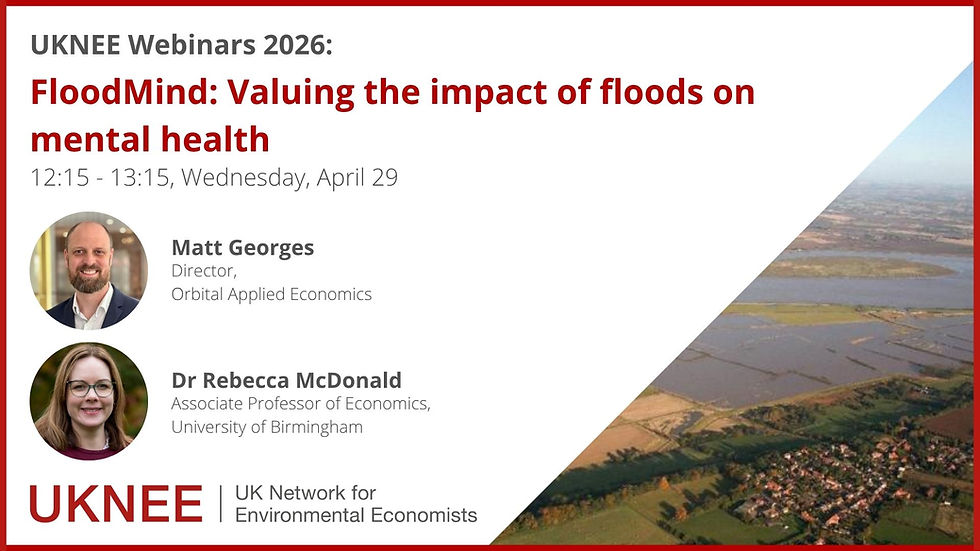
We welcome you to join us Wednesday, 29 April for an insightful presentation. You can register here.
Traditional flood risk strategies focus on the costs of damage to property and infrastructure, but we know that flooding also has severe impacts on people’s mental health. The FloodMind project was set up to address this gap: to understand the costs and benefits of interventions that protect mental health even when flooding cannot be avoided.
FloodMind was designed to lay the intellectual foundations for better decision-making in the flooding and mental health space. In the past it has been difficult to make the funding case for ‘non-structural’ interventions that do not necessarily prevent flooding but do reduce the incidence of poor mental health after a flood. The reasons are that: the causal chain between flood impact and mental health diagnosis has not been fully mapped out; the economic costs of different mental health conditions have not been formally calculated, and there has not been a tool available to combine that data into a decision-support framework.
FloodMind has made significant progress on all three of these key areas, enabling the next phase of work to produce a tool to help decision-makers understand what interventions work to protect the mental health of people who have been flooded and how much should be spent on them.
New study shows extreme heat and humidity reduce the recreational value of urban green spaces

Urban green spaces provide vital benefits to human well-being, yet increasingly frequent heat and humidity from climate change threaten to undermine their value. A new study from Wang et al. (2026) addresses this concern by quantifying welfare losses attributable to the reduced use of urban green space under intensifying summer heat and humidity. The results indicate that high temperature and humidity substantially reduce annual recreational value, with losses over 22 million USD under the most extreme conditions, highlighting the vulnerability of urban recreation to climate extremes. These findings demonstrate the importance of climate adaptation in urban planning strategies to human wellbeing.
You can find the full report here.
Annual SEEDS Conference: Call for Papers
Deadline 25 June 2026

The Annual SEEDS Conference 2026, hosted by the University of Ferrara in conjunction with the Horizon Europe BioFairNet project, will explore how circular economy and bioeconomy approaches can contribute to tackling climate change and the EU’s transition.
Contributions across all qualitative, quantitative, and mixed methodologies and disciplines from senior scholars, PhD students, and early-career researchers are all welcome.
The submission deadline is 25 June 2026. You can register for the conference here.


Comments