
envecon 2026 and January Webinars, Launch of Natural England's Science, Evidence, and Analysis Framework for Nature Recovery, Revision of Defra's Environmental Improvement Plan, Leverhulme Fellowships
In this month's newsletter, December 2025
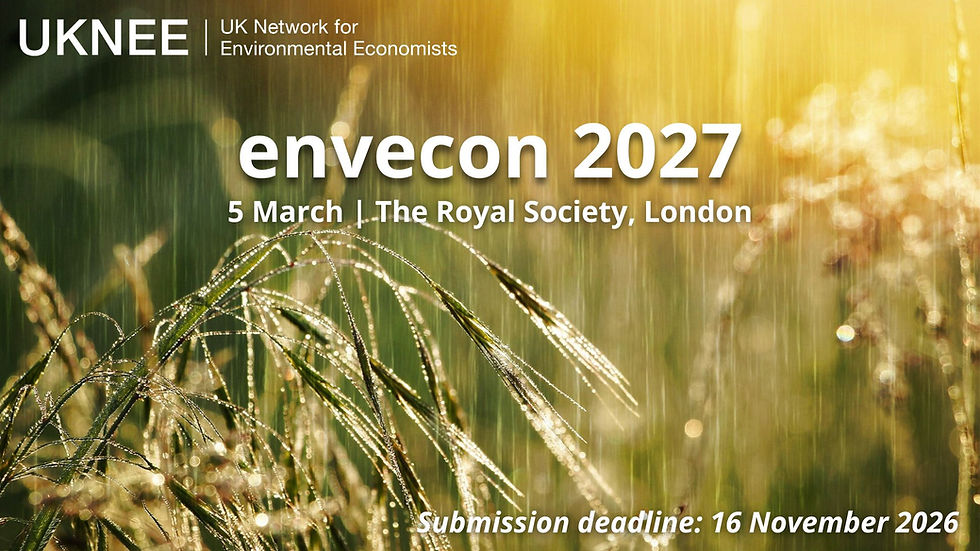
SAVE THE DATE
20th March for envecon 2026. Agenda and registration will be out early January
Two webinars in January:
27th January - 10:00-12:00 on BS ISO 14054:2025 Natural Capital Accounting for Organisations - launch webinar. Register here.
28th January -12:15-13:15 on Green Nudges and Information Avoidance with Julien Roger Jean-Pierre Picard, Politecnico di Milano. Registration after the new year.
One webinar in February: 25th - 12:15-13:15 with Andrew Schein, Centre for Net Zero, London. Registration and webinar title after the new year.
Leverhulme Early Career Fellowships 2026 at LSE
Express your interest for a postdoctoral opportunity!
Launch of Natural England's Science, Evidence, and Analysis Framework for Nature Recovery
Speakers and participants showcase cutting-edge scientific applications informing environmental policy and practice.
Revision of Defra's Environmental Improvement Plan
Five-year framework that will inform other key upcoming strategies
Leverhulme Early Career Fellowships 2026 - Expressions of Interest
Application deadline by 9 January 2026

Are you an early-career researcher within four years of completing your PhD, with a strong research agenda in economics, environmental policy, sustainability, or related interdisciplinary fields? Are you looking for support to develop an independent research profile at a UK host institution?
The Leverhulme Early Career Fellowships 2026 provide a postdoctoral opportunity with salary support and research funding to help outstanding researchers establish themselves in academia. The London School of Economics is now inviting expressions of interest ahead of the formal Leverhulme application process.
Find further details and guidance on applying via host institutions here.
Launch of Natural England's Science, Evidence, and Analysis Framework for Nature Recovery
Conference held on 4 December at the Royal Armouries, Leeds

The conference showcased cutting-edge scientific applications to inform policy and practice, including eDNA (environmental DNA) methods for species tracking, AI to analyse complex data, and innovative field projects such as monitoring sensitive seal breeding sites in Norfolk. On infrastructure, Biodiversity Net Gain is informing policy and planning, while Natural England’s ornithologists also presented evidence on seabird flight paths that are now guiding turbine placement to reduce impacts on marine habitats while meeting energy needs. These examples illustrated how emerging technologies and evidence have the potential to shape decisions across sectors to support nature recovery as part of broader economic and infrastructure planning.
These discussions were framed within Natural England’s Strategic Direction for 2025-2030, which aligns with government priorities. The framework aims to embed science into decision-making by bringing multidisciplinary approaches across the natural and social sciences, spanning biodiversity, landscape, and geodiversity.
Read the framework more here.
Revision of Defra's Environmental Improvement Plan
Five-year framework that will inform other key upcoming strategies

On 1 December 2025, Defra released a revised Environmental Improvement Plan (EIP) that sets out a five-year framework to improve England’s natural environment. The plan builds on statutory targets under the Environment Act 2021, it includes measurable commitments, and will inform the content of other key upcoming strategies, such as the Land Use Framework, farming roadmap, and the food strategy.
The EIP is structured around five interrelated chapters that collectively define ten goals for the natural environment, including clean air, chemical and pesticide risks, biosecurity, and access to nature. Several interim targets originally due by 2028 have been strengthened, others are extended into 2030 including restoring or creating 250,000 hectares of wildlife-rich habitat outside protected sites (up from 140,000 hectares by 2028 in the previous EIP), amount of Sites of Special Scientific Interests (SSSIs) to have actions on track to achieve has been pushed, and reducing phosphorus loadings from treated wastewater from 50% by 2028 to 55% by 2030.
Key measures in this version include a new interim target to reduce population exposure to fine particulate matter (PM2.5) by 30% by 2030 relative to 2018 levels. Delivery is backed by funding, including up to £500 million through the Landscape Recovery scheme to restore nature, reducing flood risk, and boosting biodiversity. The EIP 2025 includes requirements on pesticide reduction, soil health monitoring, and water quality, and other areas affecting farmers and land managers.
Read the full report here.


Comments