
envecon 2026 Call for Papers and Posters, Political Divide in Support of Meat Tax: Experimental Evidence, Assistant Professor Vacancy at LSE, and Energy Insights from Ember
In this month's newsletter, October 2025
Important dates for envecon 2026
1st December: Deadline for call for papers
20th March: Conference day!
Assistant Professor in Biodiversity Economics vacancy at LSE
Join a leading academic community at the forefront of research and teaching on the economics of biodiversity!
UKNEE monthly webinar: Political divide in support of meat tax: experimental evidence
How do meat consumption and willingness to reduce it may be linked to political ideology?
Solar and wind lead global electricity, overtaking coal
Renewable energy is now a dominant technology in the global power systems
envecon 2026 Call for Papers & Posters
Submit your abstract by 1 December 2025

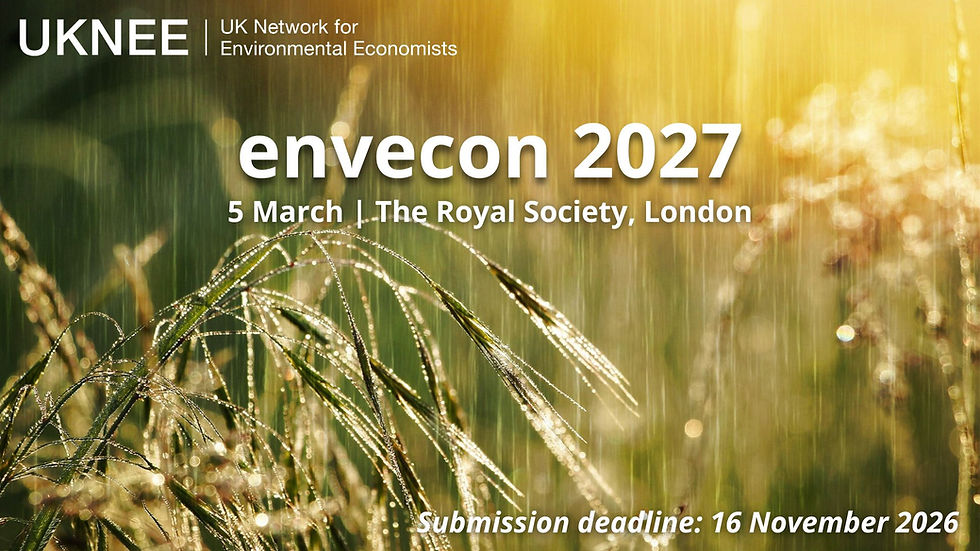
The call for papers and posters for envecon 2026, UKNEE’s annual applied environmental economics conference, is now open! The event will take place on March 20th, 2026, at the Royal Society, London.
This year’s theme focuses on ensuring nature stays part of the political and business conversations. We have the evidence showing economic goals cannot be achieved without due consideration of nature and climate. Let’s share that and discuss practical pathways for policy and markets that can achieve nature and climate positive growth.
Papers covering jobs, growth, finance, resilience in all sectors are encouraged. Please consider submitting any work you’d like to present and share this call across your networks and organisations to invite others to apply.
You can find more information, including the submission instructions, here.
Assistant Professor in Biodiversity Economics Vacancy at LSE
Application deadline by 26 October 2025

Are you researching the economics of biodiversity and ecosystems, ecological economics, or the economic aspects of nature and biodiversity policy? Do you have or close to obtaining a PhD in environmental economics or related fields?
Then you could be a great fit for the Assistant Professor in Biodiversity Economics position at LSE’s Department of Geography and Environment, in partnership with the new LSE Global School of Sustainability.
Join a leading academic community at the forefront of research and teaching on the economics of biodiversity!
Apply by 26 October. You can find more information here.
Political divide in support for a meat tax: experimental evidence
Next Webinar, October 29, with Meike Morren

October 29, 12:15 - 13:15
Click here for more details and to register
With a change in plans, Sanchayan Banerjee (King’s College London) will not be presenting. We’re pleased to welcome his colleague Meike Morren (Vrije Universiteit Amsterdam) as she explores how meat consumption and willingness to reduce it may be linked to political ideology.
Their study uses a conjoint experiment with over 8,000 participants from nationally representative samples in Denmark, Germany, the Netherlands, and the UK to examine whether support for meat reduction policies varies by political ideology. Results show that support for a meat tax decrease as costs to consumers rise but increases with redistribution and outreach, highlighting the key role of narratives in shaping political debates on meat taxation.
Solar and wind lead global electricity, overtaking coal
Energy insights from Ember

Renewable energy has overtaken coal as the world’s leading source of electricity for the first half of 2025, marking a historic milestone, according to new data from global energy think tank Ember. While electricity demand continues to grow worldwide, the surge in solar and wind power not only met all of the additional demand but also contributed to a slight decline in coal and gas use.
Solar and wind generation outpaced global electricity demand growth, with solar alone accounting for 83% of the increase. Many countries set new records for renewable generation, while fossil fuel output remained mostly flat. Fossil generation fell in China and India but grew slightly in the EU and the US, resulting in renewables surpassing coal’s share in the global electricity mix and helping to prevent further increases in CO2 emissions from the power sector.
This development confirms that solar and wind are no longer marginal technologies, they are now central to driving the global power system. The historic shift of renewables overtaking coal highlights the need for governments and industry to accelerate investment in solar, wind, and battery storage, ensuring that clean, affordable, and reliable electricity reaches communities worldwide.
Read more here.


Comments